
Local web dashboard
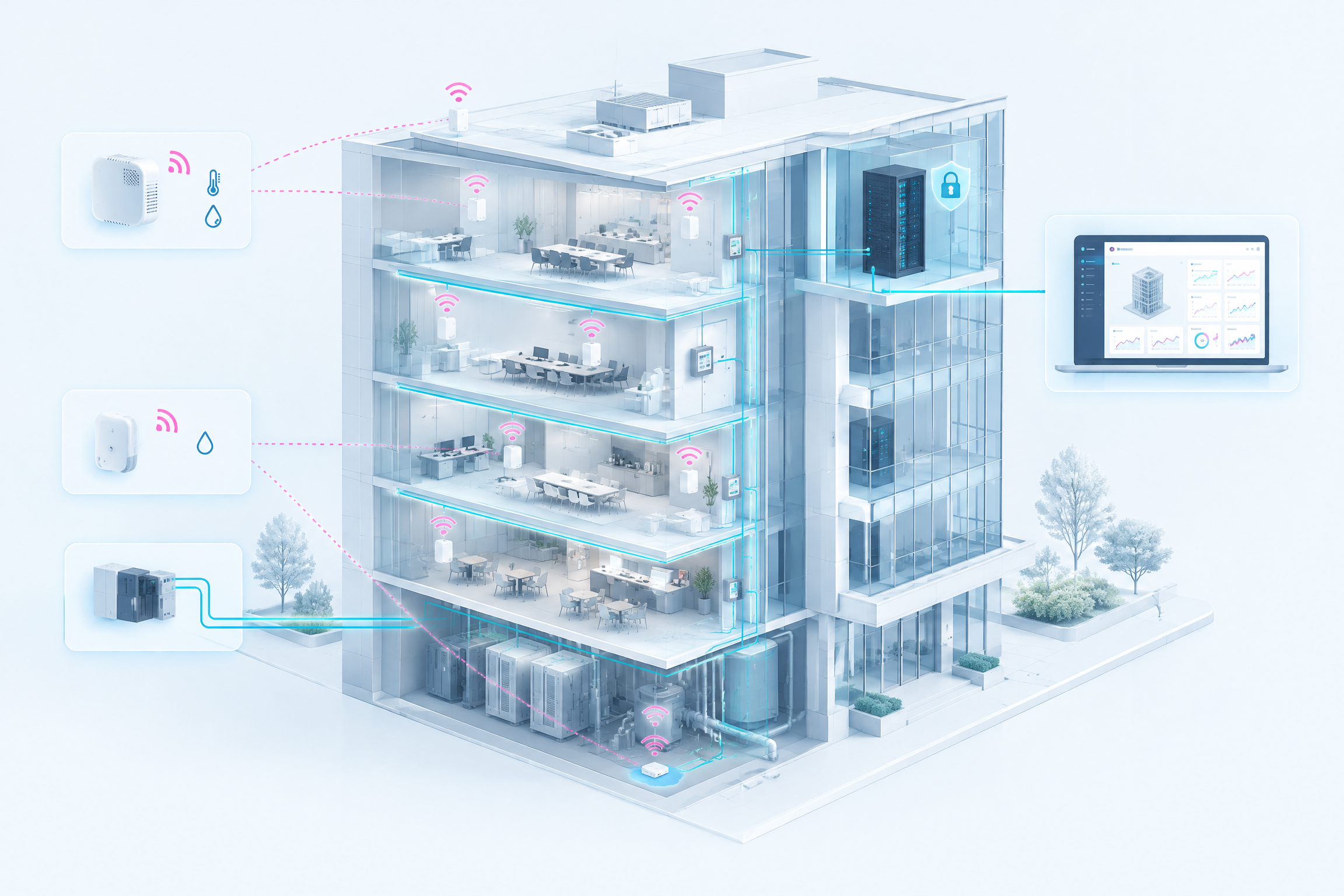
A dashboard on the building server lets facility teams monitor and control AHU, FCU and ACCU status on the internal network.
CASE_03 · BMS · Malaysia
On-premises BMS integrating legacy BACnet with wireless LoRaWAN
A secure local BMS modernisation that adds monitoring and control without dropping existing BACnet gear or sending operational data to the public cloud.
Executive summary
TNB is Malaysia’s largest electricity supplier. Its energy-services arm, TNB Energy Services Sdn Bhd (TNBES), supports energy efficiency and facility operations across commercial and institutional sites.
For utility-style and commercial facilities that need monitoring kept on a secure local network, TNBES worked with WSmart on an on-premises BMS. Existing BACnet controllers link to LoRaWAN sensors through a WSmart BMS server hosted on the building LAN — so operational data stays air-gapped.
The hybrid setup adds temperature, humidity, leak and equipment-status monitoring with a less invasive wireless retrofit, without rip-and-replace.
The challenge
Architecture pillar
WSmart designed a hybrid IoT BMS that keeps existing BACnet controllers and adds long-range LoRaWAN sensing on a closed local server.
A dashboard on the building server lets facility teams monitor and control AHU, FCU and ACCU status on the internal network.
The local BMS workstation supports real-time manual on/off switching and emergency override for connected equipment on the LAN.
Daily calendars plus holiday and event modes cut unnecessary runtime.
Local notices and visual alarms flag equipment faults, temperature thresholds and water leaks for faster response.
Equipment trends, temperature curves and status logs stay on local servers for audits and energy review.
Wireless temperature, humidity, water-leak and dry-contact sensors connect to the local BMS gateway without new cable runs.
Outcome
About WSmart
WSmart builds custom IoT systems for existing sites — web and mobile applications, dashboards and alerts, plus hardware links over protocols such as LoRaWAN, BACnet, Modbus, BLE and MQTT — so teams in Hong Kong and Malaysia get a system that fits their workflow.
Next step
Tell us the building type, floor area, what systems are already installed, and what you need to solve. We will come back with an assessment.
Book a site assessment