
Hybrid wired and wireless building management
Wired where control must be certain. Wireless where the building cannot be opened up. One unified platform.
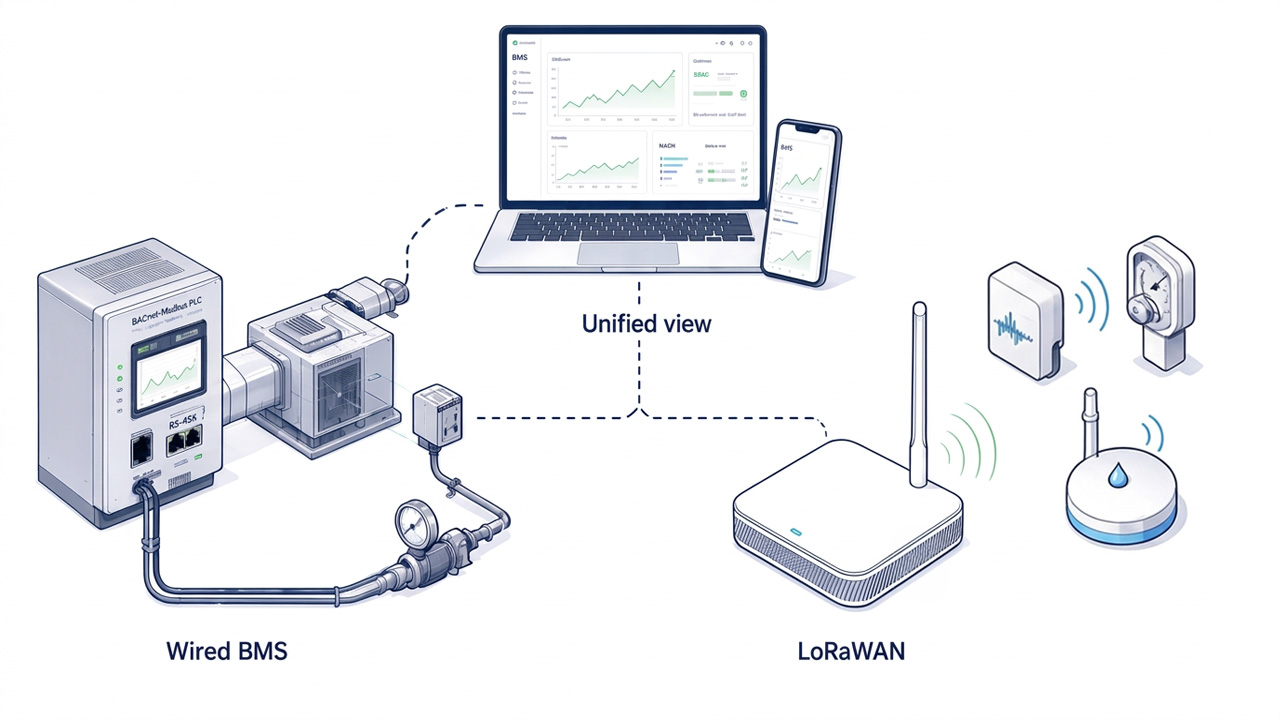
Key benefits of a hybrid BMS
Wired where control must be certain. Wireless where the building cannot be opened up.
Lower installation and retrofit costs
No extensive new cabling, trenching or disruption in occupied buildings.
Battery-powered efficiency
LoRaWAN devices last 4–10+ years on batteries — maintenance stays light.
Wider and faster coverage
LoRaWAN reaches through walls and floors to remote plant rooms, rooftops and multi-storey or campus areas.
Richer data and better optimisation
Finer sensing supports energy savings, fault detection and comfort — often with 20–40% energy reduction potential.
Scalability and flexibility
Add sensors floor by floor without rewiring.
Seamless upgrade path
Keeps your existing Modbus and BACnet investment while adding IoT sensing.
Reliability with redundancy
Wired links keep mission-critical control stable; wireless adds monitoring backup and failover.
What goes in
Wireless sensors filling the gaps your BMS does not cover
Wireless sensors filling the gaps your BMS does not cover
RS485 converted to wireless, so no new cabling
Air-conditioning control and scheduling through VRF gateways where required
Lighting control: up to 8 circuits per controller, with local override and occupancy-based switching
Energy and water sub-metering per floor or zone, with leak and anomaly detection
Washroom, occupancy and people-counting monitoring
Critical case management: water leakage, extreme temperature and smoke, with automated responses
Alarms and events log with SMS, WhatsApp, email and app notifications
Deployment on site, in the cloud, or both
VRF systems we work with
Daikin (VRV/SkyAir), Mitsubishi, LG, Samsung, Toshiba, Fujitsu (V2/J2 series), Panasonic / Sanyo, Hitachi, Gree, Midea (V4/V5/V6/V8 series), Kentatsu, Carrier, Trane, Blue Star, Chigo and Haier. Third-party product names are the property of their respective owners and indicate compatibility, not ownership or certification.
Monitoring and control are different scopes. Reading data from your existing systems and adding sensors is monitoring. Changing setpoints and running schedules is control — and it is governed by a separate authorisation. Control actions are executed by the platform only after your nominated staff approve them.
Next step
Book a site assessment
Tell us the building type, floor area, what systems are already installed, and what you need to solve. We will come back with an assessment.
Book a site assessmentFAQ
Hybrid BMS FAQ
Can we add wireless sensors to our existing BACnet BMS without replacing it?
Yes. Keep your existing BMS and control logic. Add battery LoRaWAN (or similar) sensors where rewiring would disrupt the building. An edge gateway maps readings to BACnet or Modbus — and MQTT for dashboards — so the building stays in service. Most sites pilot one floor or area before scaling.
What is a hybrid LoRaWAN BMS retrofit, and when does it make sense?
A hybrid retrofit keeps wired control where certainty matters and adds wireless sensing where the fabric cannot be opened. You get one operating view for legacy controllers and new sensors. Typical triggers are IAQ, leak, temperature or occupancy gaps — without a full capital BMS swap. WSmart acts as integrator and software layer, not hardware-only.
On-premises vs cloud BMS monitoring — which is right for utilities or security-sensitive sites?
Cloud suits multi-site FM and fast mobile response. On-premises suits sites that must keep monitoring local and controlled. The integration idea is the same: connect existing controllers plus wireless environmental or leak sensors. We help you choose based on residency, network and ops needs.